LuxynStudio
AI photography platform
A production SaaS platform designed, built, secured and operated by one person, using AI-assisted development as the primary method.
The experiment
LuxynStudio started as a deliberate experiment: take my photography and retouching skill, take AI-assisted development as the primary way of building, and see how far one person can actually take a product. Not a prototype. A real platform with paying users, real data, and real consequences if it breaks.
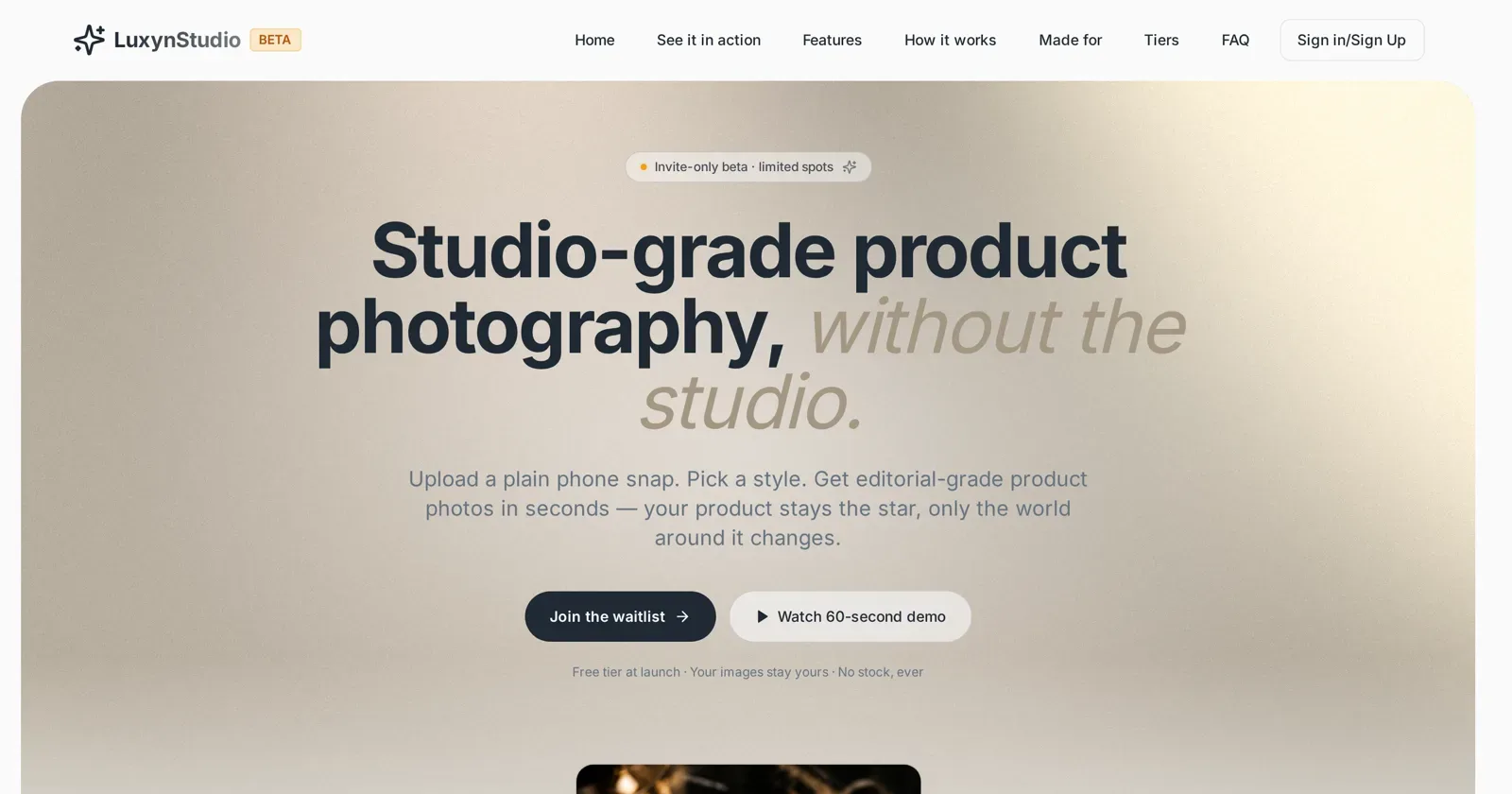
The product itself is simple to describe. Upload a plain phone snap of a product, pick a style, get editorial-grade product photos in seconds. The product stays exactly as it is; only the world around it changes. That is my photography discipline expressed as software.
Product and UX/UI design
Every screen is my own design work: the marketing site, the studio interface where generation happens, the account and billing flows, the support centre, and the full admin side.
- Designed the generation flow so a non-technical user reaches a usable image in under a minute.
- Designed a complete admin and operations interface: user centre, credit management, moderation, analytics, changelog.
- Built the design system once and applied it across dozens of screens so the product feels like one thing.
- Wrote the product copy, the onboarding, the empty states and the error messages.
What I learned to build
This is the part the experiment was really about. Everything below I learned by building it, with AI as a working partner rather than an autocomplete.
- Database schema design in Supabase, from a handful of tables to a large production schema covering generation jobs, credits, subscriptions, referrals, emails and audit trails.
- Row Level Security rules, so data access is enforced at the database and not merely in the interface.
- Realtime and notification systems: job progress, admin alerts, and in-app notifications that update without a refresh.
- A full CMS, so content, changelog entries, email templates and policy pages are edited in the product rather than in code.
- Payment gateway integration, subscription tiers, credit top-ups, refunds, and the seller-side registration required to be eligible to receive payments.
- Transactional email: templates, sending, delivery events, bounce and suppression handling, and campaign sending.
- Logging everything, so any generation, payment, auth event or failure can be traced afterwards.
- Authentication with two-factor authentication for high-security accounts, recovery codes, and rate-limited verification.
- Protecting user data: export requests, deletion and wipe flows, and keeping private files behind signed access rather than public URLs.
Cost efficiency as a design problem
Running generative AI in production is a cost problem before it is a technical one. Every image has a unit price, and a design decision that looks generous in a mockup can quietly make the product unviable.
So cost became part of the design: queued jobs instead of unbounded parallel generation, credit accounting on every operation, refunds when a job fails so users are never charged for our errors, cancellation of stale work, thumbnail generation instead of serving full-size assets, and retention sweeps so storage does not grow forever. Building it alone means I see the bill and the design decision that caused it in the same afternoon.
Why this matters for client work
Most people who can design a product cannot ship it, and most people who can ship it cannot design it. AI-assisted development collapses that gap, but only for someone who understands both sides well enough to know when the generated answer is wrong.
LuxynStudio is the proof that I can take an idea from a blank file to a secured, billed, monitored product, and make design decisions that account for what they cost to run.