UK Pavilion
Expo 2025 Osaka
Contributing artist on the visual package for the United Kingdom's national pavilion at World Expo 2025 in Osaka.
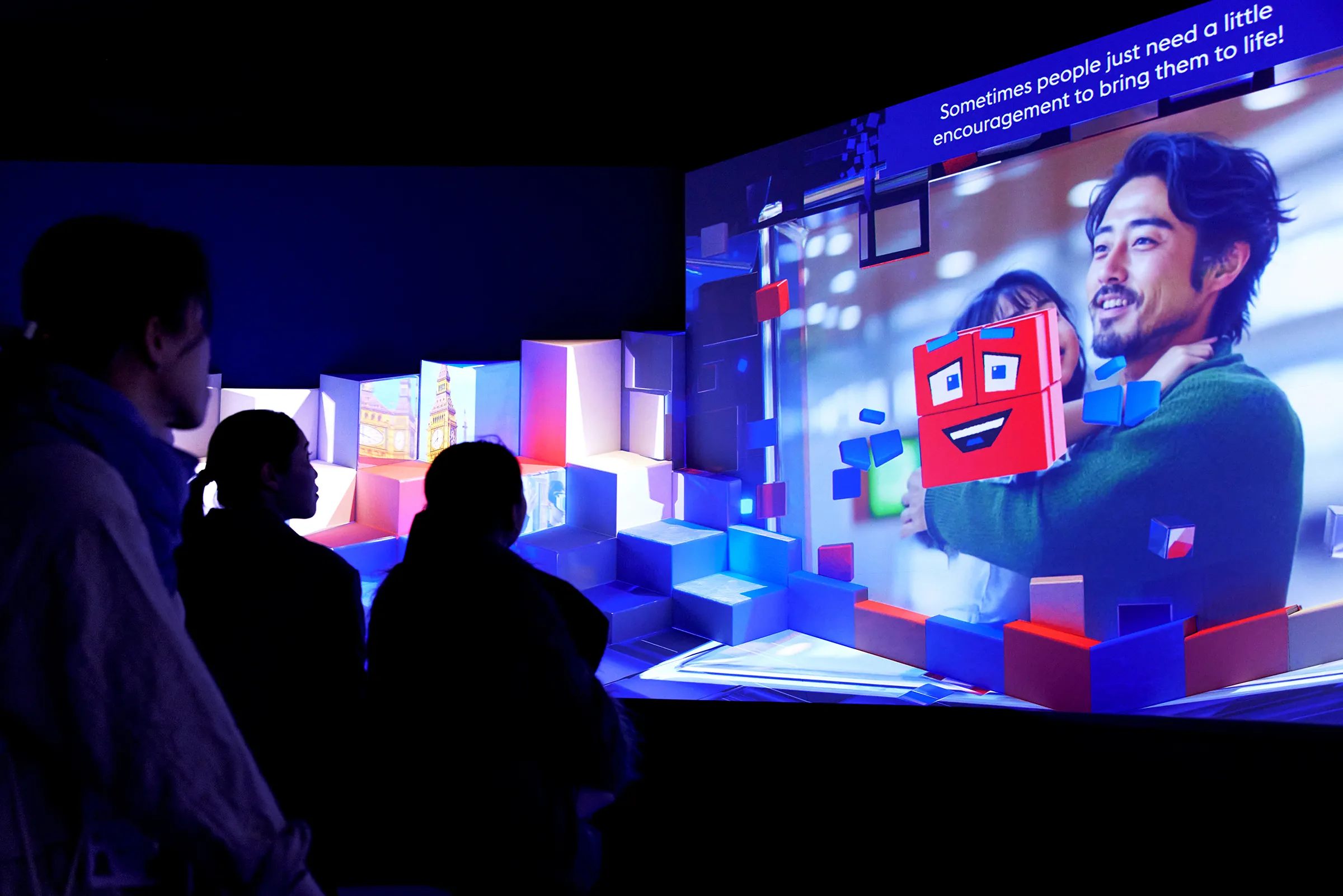
The brief
Immersive International was appointed to deliver the creative for the United Kingdom's pavilion at World Expo 2025 in Osaka, a project commissioned in partnership with the UK Government. A national pavilion is about as high-stakes as visual work gets: the imagery is reviewed by government stakeholders, published to international press, and seen by millions of visitors over six months.
I joined the team as a visual contributor, working remotely alongside the art directors. My focus was image composing and AI-assisted visual production: turning direction, references and raw renders into finished frames that held up at press resolution and stayed on-brand across the whole set.
What I contributed
- AI-assisted image compositing, blending generated elements with rendered geometry and photographic plates so the result reads as one coherent photograph, not a collage.
- Concept art and exploratory frames used to test directions quickly before committing production time.
- Visual QA across the frame set: consistency of light, lens behaviour, material response, colour and scale between images produced by different people.
- Bringing my own craft judgement and prior supervisory experience into the room, rather than only executing shot lists.
- Working both inside the team and fully independently, depending on what each deadline needed.
Working in a team and alone
The part I value most from this engagement is the mode of working. On some deliverables I was one pair of hands inside a larger art-direction pipeline, matching someone else's established look exactly. On others I was handed an objective and left to solve it end to end, from reference gathering through to the press-ready file.
Both modes need different discipline. Inside a team, the job is to make your work invisible: nobody should be able to tell which frames were yours. Working independently, the job is to make the decisions an art director would have made, and to be able to defend each one.
A separate engagement: leading the AI content team
This next part was a different project at Immersive International, not the UK Pavilion, and it matters because it is where the responsibility was highest.
On that separate high-stakes project I worked as team leader of the AI content team. The team was deliberately cross-disciplinary: photographers, digital artists, and architecture consultants, each bringing a different vocabulary to the same output. My responsibility was supervising the team and working alongside them, not simply assigning tasks.
- Set and held the visual standard, so output from very different specialists arrived consistent.
- Translated between disciplines: what an architecture consultant means by 'correct' is not what a photographer means by it.
- Reviewed, gave direction on, and corrected AI-generated and composited output before it went forward.
- Kept the team moving under a schedule where reshoots and re-renders were not an option.
What I took from it
Generative tools do not remove the need for photographic and art-direction judgement, they raise it. The frames that worked were the ones where someone understood focal length, falloff, and material behaviour well enough to notice when the model got it subtly wrong.
That combination, photographic craft plus fluency with AI production tools plus the ability to lead a mixed team, is the core of how I work on everything since.
Images © Immersive International.